
In less than three months, the Opportunity Zone map gets redrawn. On January 1, 2027, the program known as OZ 2.0 goes live, and it is now a permanent part of the tax code rather than an incentive with an expiration date (CRE Daily).
That changes the math for anyone sitting on capital gains. The first round of OZ funds launched into a pandemic and a rate shock. The second round starts with clearer rules, a rolling deferral window and extra rewards for rural investment. It also comes with a smaller map: experts expect the number of zones to shrink by more than 20%.
Here is what's changing, what the transition years mean for timing, and how investors can position before the calendar flips.
What changes under OZ 2.0
The core idea stays the same: invest capital gains in a Qualified Opportunity Fund (QOF), defer the tax, and pay nothing on new appreciation if you hold for 10 years. The details around it shift in investors' favor in some places and tighten in others.
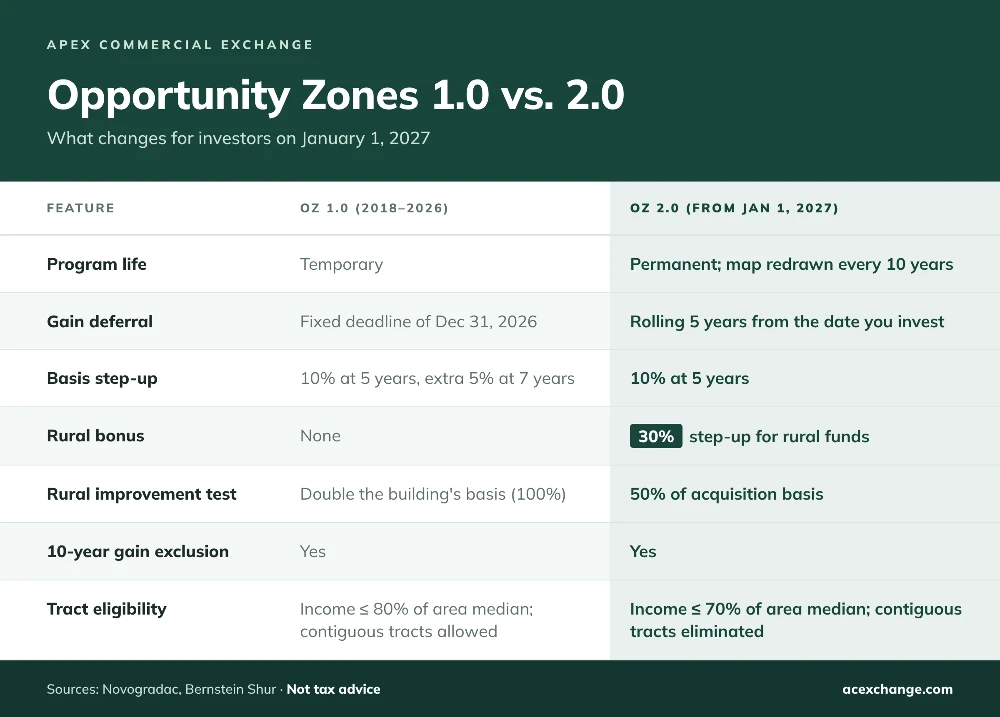
Three changes matter most for real estate buyers:
• The rolling deferral. Every investor now gets a full five years of deferral and the 10% step-up, no matter when they invest. Under OZ 1.0, late investors lost those benefits as the 2026 deadline approached.
• The rural bonus. Funds that hold at least 90% of their assets in rural zones get a 30% step-up, and rural properties only need improvements worth half their acquisition basis instead of all of it.
• A smaller, stricter map. The lower income threshold and the end of contiguous tracts mean fewer zones, concentrated in the neediest areas. More reporting to Treasury is also required.
The transition window: old map, new map
For the next two years, two maps run side by side. That overlap is where the timing opportunities are.
1. July 2025: The One Big Beautiful Bill Act makes Opportunity Zones permanent.
2. 2026: Governors nominate new tracts for Treasury to certify.
3. December 31, 2026: Gains deferred under OZ 1.0 come due on 2026 tax returns.
4. January 1, 2027: OZ 2.0 benefits and the first new map take effect.
5. 2027–2028: Investors can use both the legacy zones and the new zones (CRE Daily).
6. After 2028: Legacy zones that didn't make the new map sunset.
Two takeaways for buyers. First, a property in a legacy zone still qualifies today, but whether it carries into the new map depends on the final tract certifications. Second, many investors are timing gains to land after January 1 so they get the full five-year deferral and step-up. Some are even creating taxable "inclusion events" before year-end so they can reinvest in OZ 2.0 funds in 2027 (NAIOP).
How to position before January 1
The investors who did best in OZ 1.0 had the right property lined up before the capital arrived. Five moves for the next 90 days:
1. Map your gains. Talk to your tax advisor about when your capital gains land, and whether waiting until 2027 gets you a better deferral.
2. Watch your state's tract list. Nominations are being finalized now. Know which neighborhoods are in, and which legacy zones are dropping out.
3. Underwrite the deal first, the tax break second. A bad property in a good zone is still a bad property. Ask whether the investment works without the OZ benefits (Peachtree Group).
4. Favor value-add and conversion plays. OZ rules require you to substantially improve an existing building. Projects that already need a major renovation, like an office-to-residential conversion, meet that test naturally.
5. Stack your incentives. OZ benefits can be layered with historic tax credits and state programs, which can transform the capital stack on older buildings (Bisnow).
Acquisition basis matters too. The less you pay for the building, the less you need to spend to satisfy the improvement test, and the more of your budget goes into value creation. That is why below-replacement-cost purchases, including auction sales, pair well with OZ strategies.
Featured opportunity: a 14-story Opportunity Zone tower in downtown Shreveport
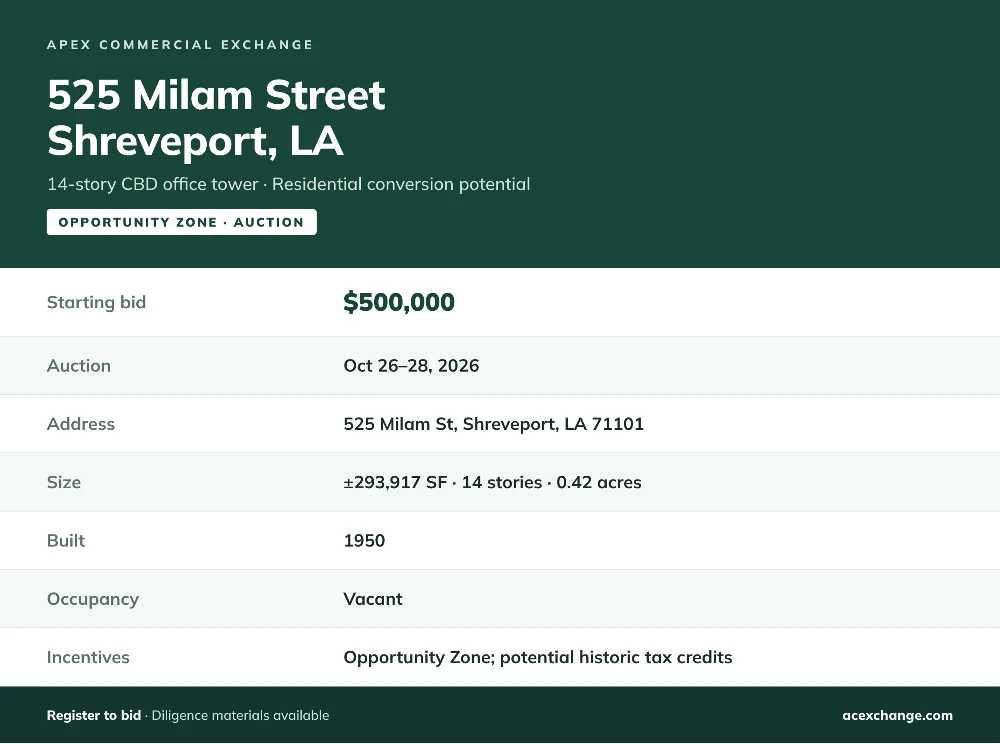
If you're looking for the kind of deal OZ investors want, 525 Milam Street checks several boxes. It's a vacant, ±293,917 SF office tower in Shreveport's Central Business District, located in an Opportunity Zone and heading to auction on Apex Commercial Exchange.
Why it fits an OZ strategy:
• A conversion candidate. The seller is marketing the building for residential, mixed-use or modernized office use. A full repositioning would easily clear the substantial improvement test.
• Incentives to layer. The listing points to federal and state programs, including potential historic tax credits for the 1950s structure.
• A low entry basis. At a $500,000 starting bid, the acquisition cost works out to under $2 per square foot before improvements.
• Downtown tailwinds. The tower sits in a walkable CBD that is benefiting from ongoing revitalization efforts.
Before bidding, confirm the tract's status under the new OZ 2.0 map and the eligibility of any historic credits with your own advisors. The diligence materials are available on the listing page.
Find your next Opportunity Zone deal
The new map takes effect January 1, but the best deals get locked up before then. Browse current auctions on Apex Commercial Exchange to find value-add, conversion and Opportunity Zone properties, or register to bid on 525 Milam Street before bidding opens October 26.
This article is for general information only and is not tax, legal or investment advice. Opportunity Zone rules are complex and tract designations are still being finalized. Consult your own tax and legal advisors before making any investment decision.
Sources