Why Medical Office Is Still One of the Most Resilient Plays in Commercial Real Estate
Office real estate has had a rough few years. Remote work reshaped demand, vacancy rates climbed in traditional corporate towers, and investors grew cautious about anything with "office" in the name. But medical office buildings (MOBs) have quietly done the opposite — holding occupancy, attracting steady tenant demand, and drawing renewed investor interest even while the broader office sector struggled.
Here's why medical office keeps outperforming, and what investors should be looking for when evaluating a deal.
Medical Office Plays by Different Rules
Traditional office demand is tied to corporate headcount and hybrid work policies. Medical office demand is tied to something far more stable: population, aging demographics, and healthcare utilization. People don't stop needing physical therapy, imaging, dental care, or specialist visits because more employees are working from home.
That difference shows up in the numbers. Medical office vacancy has consistently stayed lower than general office vacancy nationally, and tenant retention tends to be stronger — healthcare tenants build out expensive, specialized spaces (imaging suites, exam rooms, surgical centers) and are far less likely to relocate than a typical office tenant subletting a few desks.
What Makes a Medical Office Asset Attractive to Investors
When evaluating medical office opportunities, a few characteristics tend to separate the strong deals from the mediocre ones:
Location near hospital systems or dense residential population. Proximity drives both patient volume and tenant demand.
Parking ratios well above standard office norms. Medical tenants generate much higher visitor traffic per square foot than a typical office user, so a building with 3+ spaces per 1,000 SF has a real leasing advantage.
Recent capital improvements. Medical buildouts are expensive, and buyers want to avoid inheriting deferred maintenance on top of tenant improvement costs.
A mix of in-place income and lease-up upside. The best value-add deals combine existing cash flow with room to grow net operating income through leasing available space.
Diversified tenant rosters. A mix of medical and traditional office tenants can reduce concentration risk while still capturing the stability medical tenants provide.
A Current Example: 555 Perkins Ext, East Memphis
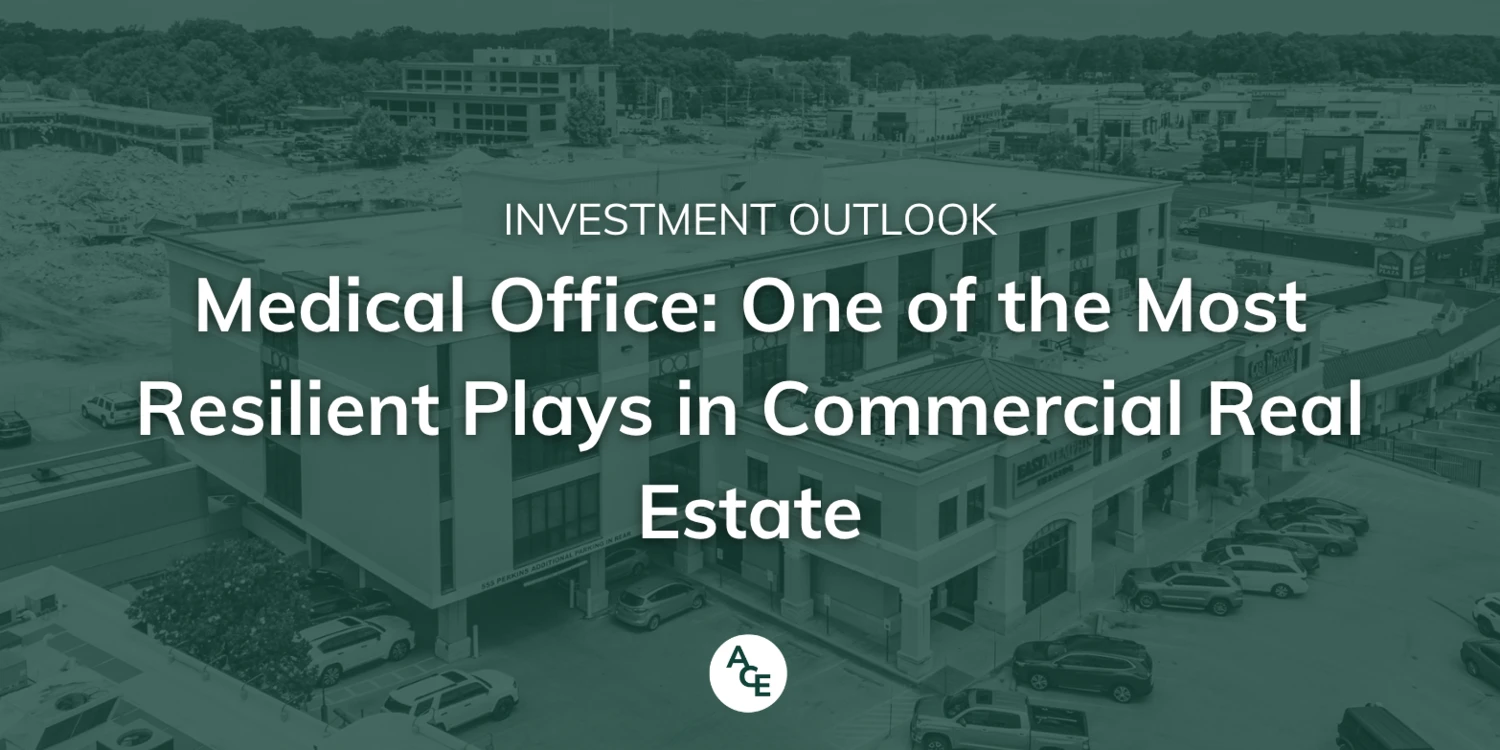
A listing currently heading to auction illustrates several of these characteristics well. 555 Perkins Ext, a 58,032-square-foot, four-story medical and traditional office building in East Memphis, Tennessee, is being marketed by CBRE through Apex Commercial Exchange.
A few details worth noting from an investment-criteria standpoint:
The building was rebuilt in 2009, with all office suites reconstructed from shell between 2009 and 2019 — meaning a buyer isn't stepping into deferred capital needs typical of a 1966-vintage building.
205 parking spaces work out to roughly 3.5 per 1,000 square feet, well above the general office market and a meaningful advantage for medical tenants specifically.
The property is 70.11% occupied as of July 2026 with a 6.43-year weighted average lease term, providing in-place income alongside a clear runway to lease up the remaining space.
A ±2,550 SF ground lease outparcel (restaurant use, lease through 2038) adds a secondary, largely passive income stream to the deal.
The building sits directly in the path of major redevelopment activity along the Poplar corridor, including the Oak Court Mall mixed-use project immediately adjacent, and a newly announced 50,000+ SF mixed-use development nearby.
It's a fee simple, non-contingent sale with financing available, structured as an auction through Apex Commercial Exchange's platform. Starting bid is $1,250,000, with bidding running July 27–29, 2026.
Whether or not this specific asset fits your strategy, it's a useful reference point for what to look for when medical office deals come to market: recent renovation history, strong parking ratios, existing income with visible upside, and a location backed by broader area investment.
Full listing details, diligence materials, and bid registration for 555 Perkins Ext →
The Bigger Picture
Medical office isn't immune to headwinds; interest rates, construction costs, and reimbursement pressures on healthcare tenants all matter. But the underlying demand driver (people needing care, close to where they live) isn't going anywhere. For investors looking to diversify into office exposure without betting entirely on corporate return-to-office trends, medical and mixed medical/traditional office assets remain one of the more defensible corners of the market.
Property details referenced above are drawn from the official listing on Apex Commercial Exchange. Prospective buyers must register and review all diligence materials directly on the listing page.