_large.webp)
Jacksonville, Florida has quietly become one of the most compelling hotel investment markets in the Southeast — and the data backs it up. With a population that crossed 1 million in 2024, over 8 million annual visitors, $7.4 billion in tourism-driven economic activity, and a business base that draws corporate travelers year-round, Jacksonville offers hotel investors a rare convergence of fundamentals: a growing population, diversifying demand drivers, and a branded supply pipeline that signals institutional confidence.
Jacksonville at a Glance: The Numbers That Matter
Before diving into the fundamentals, here's a snapshot of the data that is turning investor attention toward Jacksonville's hospitality market.
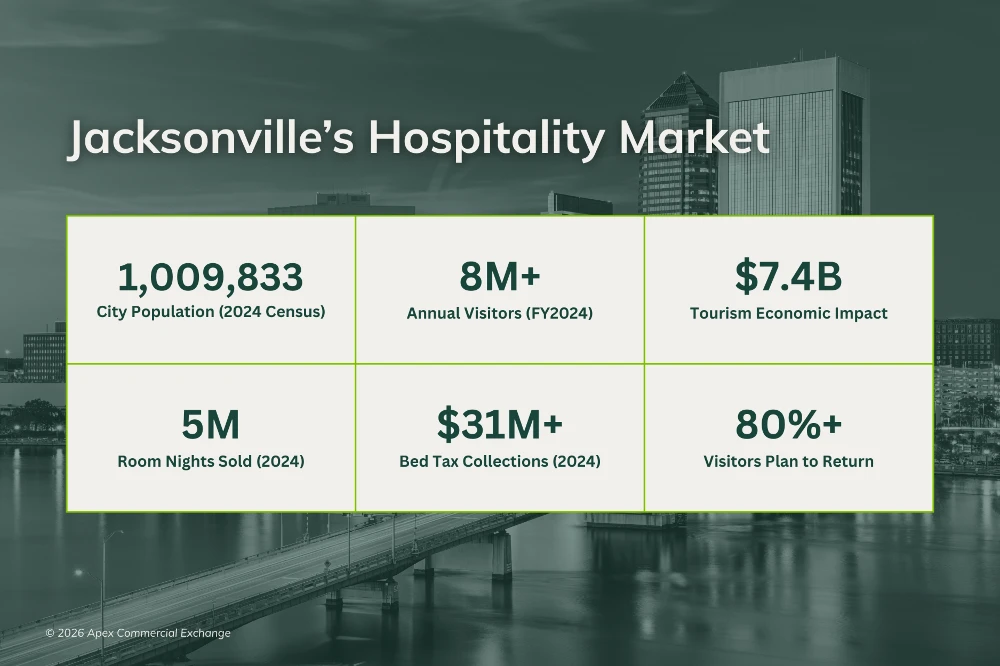
Source: Downs & St. Germain Research, U.S. Census Bureau (Vintage 2024), Duval County Tax Collector
1. Population Growth: Jacksonville Crosses the Million-Resident Milestone
Jacksonville crossed a historic threshold in 2024: it officially surpassed 1 million residents, reaching a population of 1,009,833, according to the U.S. Census Bureau's Vintage 2024 estimates. This makes Jacksonville the 10th most populous city in the United States — and one of only two U.S. cities to cross the million-person mark in the most recent estimates.
Source: U.S. Census Bureau Vintage 2024 via HereJacksonville.com
The broader metro area reached 1,360,000 residents in 2025, growing at a consistent 1.1–1.2% annually. Oxford Economics estimates that net in-migration in 2024 alone totaled 31,700 people, with a further 20,500 new residents projected by year-end 2025. Looking further out, net in-migration through 2029 is forecast to surpass 97,000 — a structural tailwind for hospitality demand.
Source: Oxford Economics / Hillis Properties: Jacksonville Population & Migration Analysis
Why Population Growth Matters for Hotel Investors
Population growth is the long-run engine of lodging demand. More residents mean more inbound visits from family and friends, more corporate relocations, more conventions, and a larger addressable local workforce that hospitality operators can draw from. For hotel investors underwriting stabilized cash flows, a city at 1 million and growing offers a demand base that most secondary markets cannot replicate.
Jacksonville ranked among the 15 U.S. cities with the largest numeric population increase (July 2023–July 2024)
Source: News4Jax: Jacksonville Among 15 Cities with Most Population Growth in 2024
2. Tourism Demand: 8 million Visitors, $7.4 Billion in Economic Impact
Jacksonville's tourism profile has matured significantly. A 2025 report by Tallahassee-based Downs & St. Germain Research found that fiscal year 2024 saw over 8 million visitors arrive in Jacksonville, generating $7.4 billion in economic impact and over $4 billion in direct tourist expenditures.
Source: Downs & St. Germain Research via News4Jax: Jacksonville Top Tourist Destination 2024
Source: Visit Jacksonville FY2024 Visitor Tracking Executive Summary Report
The data is equally compelling at the hotel level.In 2024, nearly 5 million room nights were sold across Jacksonville hotels, producing over $31 million in bed tax collections for Duval County. For context, that bed tax revenue is a real-time indicator of lodging RevPAR health — and $31 million represents strong absorption across the market's approximately 20,000 guestrooms.
Perhaps most encouraging from an investor's perspective: more than 80% of visitors to Jacksonville in FY2024 indicated plans to return. That repeat-intent rate is a rare signal of a market building genuine destination equity, not just passing through.
Source: Downs & St. Germain Research (2025) — Full FY2024 Visitor Survey
3. Beach Proximity: A Leisure Demand Driver That Doesn't Depreciate
Unlike many inland metro markets where hotel demand is entirely corporate-dependent, Jacksonville benefits from a natural demand diversifier: 22 miles of Atlantic coastline and beach communities including Jacksonville Beach, Neptune Beach, Atlantic Beach, and the luxury enclave of Ponte Vedra Beach.
Source: Visit Jacksonville (Official Tourism Authority): Jacksonville Beaches & Water
Beach proximity creates leisure demand that is structurally resilient — not tied to a single corporate tenant, convention calendar, or economic cycle. Hotels within 30 minutes of Jacksonville's beaches capture demand from multiple traveler segments: leisure visitors on weekend getaways, traveling families during school breaks, and overflow from TPC Sawgrass during The Players Championship.
This demand diversity is precisely why branded hotel operators continue to invest in the market. The Margaritaville Beach Hotel Jacksonville Beach opened in 2021 — the first Margaritaville hotel opened that year — signaling the market's ability to support lifestyle and lifestyle-adjacent product — a flag that does not enter markets without underwriting conviction. Meanwhile, the AC Hotel by Marriott Jacksonville St. Johns Town Center and Delta Hotels by Marriott Deerwood have added branded supply near the Southside's corporate corridor, serving both business and drive-in leisure travelers.
Source: 904 Happy Hour: Margaritaville Beach Hotel Jacksonville Beach Opening (2021)
Source: HVS Consulting & Valuation: Jacksonville Hotel Development Pipeline Report (2024)
4. Corporate Travel and the Business Base: Jacksonville's Rapidly Expanding Economy
Jacksonville is not only a leisure market. It is home to more than 150 corporate, regional, and divisional headquarters — and its job market has ranked among the nation's elite. According to a Wall Street Journal and Moody's Analytics analysis of 380 U.S. metro areas, as reported by JAXUSA Partnership (April 2024, based on 2023 data), Jacksonville ranked #2 in the nation for hottest job market — second only to Salt Lake City — and the top-ranked Florida metro, outpacing Orlando (#3), Tampa (#4), and Miami (#6). The ranking measured five indicators: unemployment rate, labor force participation, job growth, labor force growth, and wage growth.
Source: JAXUSA Partnership: Jacksonville Ranked #2 Hottest Job Market (reporting WSJ / Moody's Analytics analysis, April 2024)
That momentum has carried into 2025. FloridaCommerce reported that as of August 2025, the Jacksonville metro area posted the fastest over-the-year job growth rate in Education and Health Services among all U.S. metro areas — a sector directly tied to medical travel demand and hospital-adjacent hotel occupancy.
Source: FloridaCommerce: Jacksonville Metro Area August 2025 Employment Data
5. Jacksonville's Hotel Market: Supply, Performance, and Investor Activity
Jacksonville's hotel market encompasses approximately 20,000 guestrooms in Duval County. What distinguishes Jacksonville from peer secondary markets is that it sustained a robust hotel development pipeline even while many U.S. markets slowed following the pandemic. Over 9% of the county's guestroom inventory was added between January 2021 and June 2024 — a figure that reflects developer and brand confidence in the market's demand trajectory.
Source: HVS via HospitalityNet: Jacksonville Hotel Development Pipeline Despite Economic Uncertainty (July 2024)
To appreciate why Jacksonville stands out today, it helps to understand the national backdrop. 2025 marked the first full year of declining U.S. hotel occupancy and RevPAR since the pandemic — occupancy fell to 62.3% and RevPAR dropped to $100.02, according to CoStar data. In that environment, capital became sharply selective. Lenders and investors rotated away from oversupplied or single-demand-driver markets toward cities with structural growth stories, diversified demand bases, and demonstrated transaction liquidity. Jacksonville is precisely that market.
Source: Hotel Dive / CoStar: Full-Year 2025 U.S. Hotel Performance Decline (January 2026)
Jacksonville's hotel market encompasses approximately 20,000 guest rooms in Duval County. Even as national supply growth slowed in 2025 — with rooms under construction falling 7.1% quarter-over-quarter due to tariff uncertainty — Jacksonville's pipeline has remained active, underpinned by demand generators that are structural rather than cyclical. Over 9% of Duval County's guestroom inventory was added between January 2021 and June 2024, and approximately 2,000 additional rooms remain under construction or in early development. Branded flags currently entering or expanding include Hilton, Marriott, and Delta Hotels. This is developer conviction expressed in permits and construction draws — not marketing language.
Source: HVS via HospitalityNet: Jacksonville Hotel Development Pipeline Despite Economic Uncertainty (July 2024)
Jacksonville's competitive advantage is its demand diversification. While leisure-only markets softened as travel normalization reset pricing power, Jacksonville's occupancy base draws from leisure, corporate, military, healthcare, and events segments simultaneously. That mix is why the market ranked among the top five U.S. markets nationally in occupancy and RevPAR recovery strength after the pandemic — and why branded developers continued to build here while others paused.
Source: Downtown Investment Authority (DIA): Beds for Heads — Hotel Construction Booming in Jacksonville
The $6.5 Billion Downtown Development Pipeline: A Hospitality Multiplier
Perhaps the single most compelling structural argument for Jacksonville hotel investment is the $6.5 billion in active and planned projects currently reshaping downtown. This is not speculative pipeline; it is cranes-in-the-sky, permits-issued, capital-deployed investment that fundamentally alters the demand base for downtown and urban-proximate hotel assets.
Source: Downtown Investment Authority: Downtown Jacksonville's $6.5 Billion Development Boom
Major projects within this pipeline include the
$1.4 billion EverBank Stadium renovation (slated for completion in 2028)
the Gateway Jax Pearl Square development — a $750 million, nine-block mixed-use neighborhood delivering 1,250+ residences, a boutique hotel, and 200,000 sq ft of retail, as the first phase of Gateway Jax's broader $2 billion downtown investment across 25 city blocks;
the $693 million RiversEdge waterfront project on the Southbank, a 34-acre mixed-use destination with 950 residential units, a 147-room hotel, marina, and four public riverfront parks, now under active construction;
Together, these projects are driving residential density, foot traffic, and the type of street-level activation that supports sustained hotel demand well beyond the convention and events calendar.
Source: Gateway Jax: Pearl Square & $2B Downtown Pipeline — Official Project Page
Source: DIA: Gateway Jax Breaks Ground on Second Pearl Square Building (May 2025)
Source: RiversEdge Jacksonville: Official Project Site — $693M Southbank Development
Source: Jax Daily Record: RiversEdge First Residential Move-Ins (April 2025)
Source: Jax Daily Record: LaVilla Site Selected for UF Jacksonville Campus & Semiconductor Institute
The Four Seasons: Jacksonville's $360M Signal to Global Capital
In February 2026, developers Shanna Collective and Iguana Investments (the real estate arm of Jacksonville Jaguars owner Shad Khan) secured a $360 million construction loan from Goldman Sachs Private Bank. This is the largest private construction loan in Jacksonville's recorded history.
Source: Multi-Housing News: Shanna Collective & Iguana Investments Secure $360M for Four Seasons Jacksonville (Feb 2026)
When Goldman Sachs commits $360 million to a luxury hospitality asset in a city, it is making a data-driven statement about that city's trajectory.
Transaction Evidence: The $28.5M Hilton Garden Inn Trade
Within the branded midscale segment, transaction evidence is equally compelling. The Hilton Garden Inn Jacksonville Ponte Vedra Sawgrass sold in August 2025 for $28.5 million — traded by Newport Beach-based T2 Hospitality. The seller, Noble Investment Group, had acquired the property for approximately $13 million in 2021 and completed a $2.2 million renovation before exiting — a classic value-add playbook executed successfully in a compressed hold period.
Source: Jax Daily Record: Sawgrass Hilton Garden Inn Sells for $28.5M (August 2025)
6. The Investment Case for Jacksonville Hospitality Assets
Putting the data together, Jacksonville presents a hospitality investment thesis built on compounding fundamentals rather than a single catalyst:
Population at scale and still growing — 1M+ city, with 97,000+ additional residents projected through 2029
Diversified demand — leisure (beaches, attractions), corporate (150+ HQ, Fortune-tier employers), healthcare, military, and convention
Tourism momentum — 8M visitors, $7.4B economic impact, 80%+ repeat-intent rate
$6.5B downtown development pipeline — $2.5B under active construction, creating sustained demand from workers, residents, and visitors
Goldman Sachs $360M record loan for Four Seasons — largest private construction loan in city history, underwritten February 2026
Institutional brand activity — Hilton, Marriott, Delta, Four Seasons, and Margaritaville all expanding supply, signaling global underwriting confidence
Florida's structural advantages — no state income tax, pro-business regulatory environment, and consistent domestic in-migration
FEATURED LISTING ON ACEXCHANGE.COM (Apex Commercial Exchange®)
Now Available: Institutional Sale | Hilton Garden Inn Jacksonville JTB/Deerwood Park— Listed on ACExchange.com
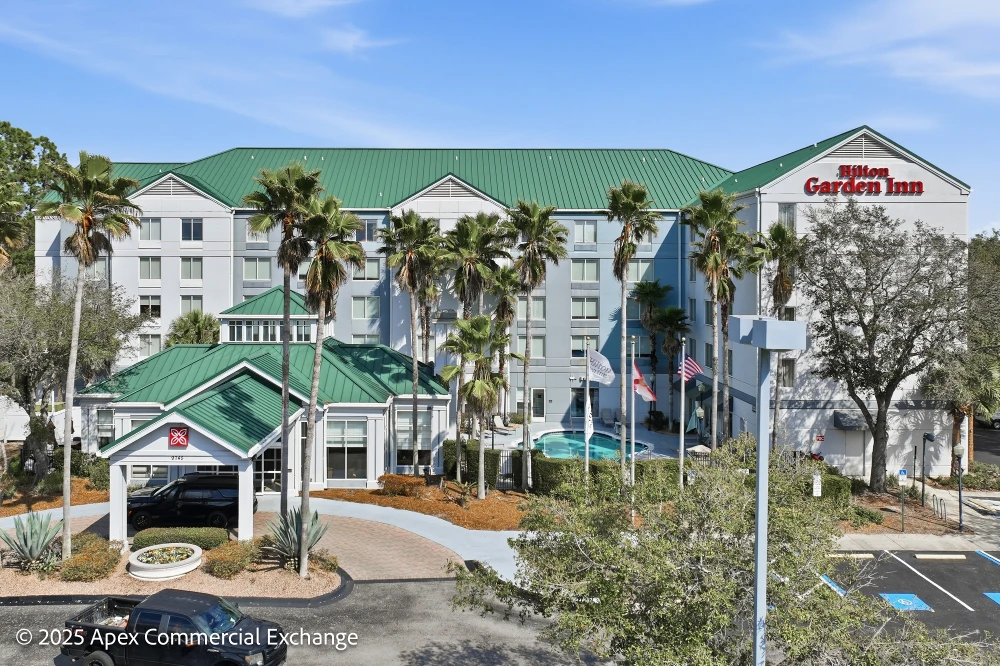
For investors looking to enter or expand exposure to the Jacksonville hospitality market, a compelling opportunity is currently available on ACExchange.com: the Hilton Garden Inn Jacksonville.
The Hilton Garden Inn brand is one of Hilton's highest-performing upper-midscale flags globally — engineered for business travelers while capturing leisure demand, with strong brand recognition, loyal corporate accounts, and Hilton Honors program distribution that drives consistent occupancy.
Jacksonville as the operating context elevates this opportunity further. A Hilton Garden Inn in a market posting 8 million annual visitors, anchored by 150+ corporate HQ, proximate to Atlantic beaches, and supported by structural population growth creates a multi-demand lodging asset capable of performing across market cycles.
Why ACExchange.com for Hotel Investment Opportunities
Apex Commercial Exchange® is a technology-enabled commercial real estate auction platform delivering AI-powered, data-driven execution for property owners, investors, and brokers nationwide. Designed by dealmakers, the platform brings transparency, speed, and market-ready precision to every transaction—helping clients confidently ACE THE AUCTION®. The Hilton Garden Inn Jacksonville represents exactly the type of flagged, income-producing asset that institutional and private equity hotel investors are actively targeting in today's market.
View the full listing and investment details at: Institutional Sale | Hilton Garden Inn Jacksonville JTB/Deerwood Park
Conclusion: Jacksonville Is a Hospitality Market for Serious Investors
The data-driven case for Jacksonville hospitality investment is no longer speculative — it is evidenced at every level of the capital stack. Goldman Sachs just wrote the largest private construction loan in Jacksonville's history ($360 million for the Four Seasons). The city's downtown has $6.5 billion in active and pipeline development with $2.5 billion under active construction. Tourism hit 8 million visitors and $7.4 billion in economic impact in a single fiscal year. And the city itself crossed 1 million residents for the first time.
This is not a market requiring a leap of faith. It is a market where the institutional capital has already moved — and the fundamentals justify following it.
For investors seeking institutional-quality exposure to Jacksonville's hospitality growth story, the Hilton Garden Inn Jacksonville — listed on ACExchange.com — represents a high-conviction entry point backed by every fundamental driver analyzed in this report.
This article is published for informational and marketing purposes by ACExchange.com. All data sourced from U.S. Census Bureau, Downs & St. Germain Research, HVS Consulting & Valuation, , CBRE Hotels, Oxford Economics, JAXUSA Partnership, Goldman Sachs / Multi-Housing News, Downtown Investment Authority of Jacksonville, and public transaction records. Hotel investment involves risk. Investors should conduct independent due diligence.