
Boston Office Market: Why Investors Are Watching Pricing Reset Opportunities
Boston’s office market is not fully recovered. Vacancy remains high. Many older buildings are still under pressure. But the market is no longer falling as fast as it was a year ago.
As of Q4 2025, Boston’s overall office vacancy stood at 18.2%, having stabilized after several years of sharp increases, according to Cushman & Wakefield. The second half of 2025 delivered one of the strongest periods of positive net absorption since the pre-COVID era, and leasing activity reached its highest annual total since 2019, per Avison Young.
That is the key shift investors should watch.
The Current Landscape: Boston Office Market by the Numbers
Greater Boston’s office market encompasses approximately 189 million square feet of inventory across the urban core, Cambridge, and suburban submarkets. Understanding where the market stands today requires examining several interconnected data streams: vacancy, absorption, leasing, rents, and employment.
Vacancy: Elevated but Stabilizing
Vacancy Stabilizing: Before the pandemic, vacancy sat at roughly 6.7%. Q4 2025 data shows overall vacancy ticking up only 10 basis points quarter-over-quarter to 18.2% (Cushman & Wakefield’s Q4 2025 report).
The Savills availability rate—which includes sublease space—declined from 24.4% to 22.2% year-over-year, a notable improvement (Boston.com).
_medium.webp)
“Downtown Boston’s office core is quietly putting together one of the most durable recoveries in the region, with the Downtown Boston Alliance area posting several consecutive quarters of improving fundamentals.” Liz Berthelette, head of Northeast Research and National Life Science Research for Newmark
Absorption: Turning Positive
Net absorption—the most telling measure of real demand—shifted decisively positive in the second half of 2025. In Q4 2025, Greater Boston office vacancy stood at 18.2%. The same period also saw 67,425 square feet of positive net absorption. That was important because it marked the first positive quarter of absorption in more than two years. Annual leasing volume also improved and reached about 7.6 million square feet in 2025. Cushman & Wakefield
Leasing Activity: Strongest Since 2019
Perhaps the most encouraging signal comes from leasing volume. The total market recorded 7.6 million square feet of leasing activity in 2025, per Cushman & Wakefield. [
According to Avison Young’s Q4 2025 report, leasing activity across Greater Boston reached its highest annual total since 2019, continuing a three-year upward trend.
Notable 2025 lease transactions that underscore this momentum include Hasbro’s 264,395-square-foot deal at 400 Summer Street in the Seaport (a relocation from Pawtucket, Rhode Island) and Schneider Electric’s 74,635-square-foot lease at Winthrop Center downtown, establishing its new North American headquarters (JLL Q3 2025).
“All of the big speculative buildings, they’re built, they’re in the ground. There’s not a lot of empty, unspoken for space that’s still in the pipeline.” — Jeff Myers, Director of Research, Colliers
The Pricing Reset: Where Opportunities Are Emerging
Boston's office sector is repricing. Elevated vacancy, higher rates, and forced sales have created the deepest discount environment in decades—especially for Class B and value-add assets. For CRE auction investors, this is the core opportunity.
Sale Prices: Signs of a Floor
Investment sales activity rebounded measurably in 2025. Avison Young reports that average office sale prices across Greater Boston rose to $232.83 per square foot, up from a 2024 low of $187.90 per square foot.
However, these averages mask the deep discounts available on individual assets. Nationally, approximately 46% of all office properties sold in 2025 traded at a discount to their prior sale price, up from 20% in 2021, per Yardi Matrix. Among premium urban-core assets, more than 70% of A-rated buildings sold below prior valuations.
Boston-Specific Discount Transactions
Several recent Boston transactions illustrate the magnitude of repricing available to auction buyers:
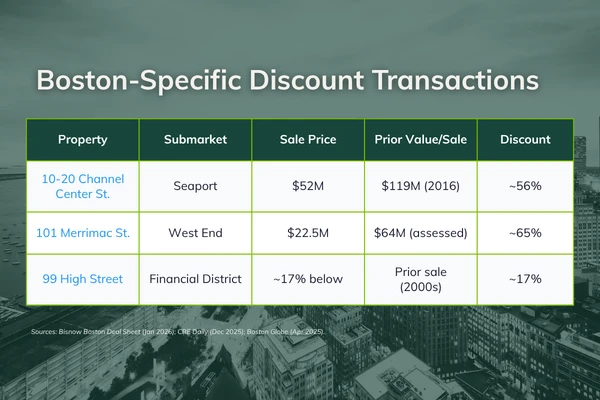
The Seaport’s Channel Center transaction is particularly instructive. North Colony Asset Management acquired the 251,000 SF building from LaSalle Investment Management for $52 million—less than half its 2016 purchase price of nearly $119 million (Bisnow). The building lost its proximity advantage after GE canceled plans for a $200 million headquarters nearby and vacated its space in 2022.
Meanwhile, in a rare counter-trend, Blackstone scored a modest premium on a Back Bay office sale in late 2025, demonstrating that well-located, high-quality assets can still command strong pricing—and underscoring the bifurcation between trophy and commodity product.
Cap Rates and Investor Composition
Nationally, the average office cap rate rose 90 basis points since 2022 to 7.6% in 2025, according to Marcus & Millichap. This represents a meaningful shift in the risk-return profile that is attracting a different buyer pool.
Private investors, who historically constitute about 30% of office buyers, now account for roughly 50% of acquisitions. Owner-users, typically 5–8% of the buyer pool, have risen to approximately 13%.
The Supply Side: Why the Pipeline Matters for Investors
One of the strongest structural tailwinds for Boston office investors is the dramatic contraction in the construction pipeline. This factor alone may justify long-term conviction.
Colliers reports that all this cycle’s major speculative projects have been completed, and the amount of underway construction has fallen to its lowest level in 20 years. The remaining 750,000 square feet under construction comprises build-to-suit projects that should not significantly impact market vacancy.
“All of the big speculative buildings, they’re built, they’re in the ground. There’s not a lot of empty, unspoken for space that’s still in the pipeline.” — Jeff Myers, Director of Research, Colliers
While Boston will still lead all major U.S. metros in 2026 deliveries—accounting for about 10% of the national pipeline despite representing only 4% of inventory—these are largely upscale, lab-oriented projects, many of which are pre-committed (Marcus & Millichap).
Office-to-Residential Conversions: A Market-Stabilizing Force
Boston’s Office to Residential Conversion Program, launched by Mayor Michelle Wu in October 2023, has emerged as a meaningful supply-reduction mechanism with direct implications for office market recovery.
According to the City of Boston, the program has received 22 applications to convert 1.2 million square feet of office space across 27 buildings into 1,517 new homes, including 284 income-restricted units.
Key program incentives include a 75% tax abatement for 29 years, as-of-right zoning in the downtown area, and a fast-tracked permitting process (Builder & Developer Magazine).
For office investors, these conversions serve a dual purpose: they permanently remove obsolete, low-quality inventory from the market (reducing overall vacancy) while simultaneously creating a viable alternative use that supports asset pricing for underperforming buildings.
Employment and Economic Fundamentals
The “Eds & Meds” Anchor: Boston’s Structural Advantage
Boston fundamentally different from most U.S. office markets. The metro’s economy is anchored by an unparalleled concentration of universities and health systems—collectively known as “Eds & Meds”—that function as permanent, recession-resistant employment engines.
An independent study commissioned by the Greater Boston Chamber of Commerce found that Massachusetts’s hospitals, universities, and colleges produce $155.9 billion in annual economic activity, supporting over 858,000 jobs and $71.1 billion in employee compensation statewide. In Boston alone, Eds & Meds generate $69.5 billion in economic activity and support 353,000+ jobs—more than 2 in 5 of all Eds & Meds jobs statewide.
The numbers are staggering. The Boston Consortium for Higher Education—just 24 member institutions including Harvard, MIT, Boston University, Northeastern, and Tufts—carries a combined payroll of $6.3 billion and employs approximately 144,000 people (Boston Consortium). These institutions don’t relocate during downturns—they are permanent anchors that generate consistent office-using employment in healthcare administration, research, legal, financial, and professional services.
Current Labor Market: Flat but Stabilizing
Marcus & Millichap projects that the Boston metro area will add 6,000 jobs in 2026, marking the region’s largest annual employment gain since 2023. While modest by historical standards, net job creation—combined with a tightening labor market that may accelerate return-to-office trends—supports incremental office demand growth.
The BLS also reported that Massachusetts had 129,000 job openings in December 2025, with a job openings rate of 3.3%. This indicates continued labor demand despite softer headline employment figures—a positive signal for office occupancy.
The Investment Case: Why CRE Auction Buyers Should Be Watching
The convergence of multiple factors makes Boston’s office market particularly attractive for auction-oriented investors right now:
Pricing Discovery: Distressed sales have established clear pricing benchmarks after years of bid-ask gridlock. Average Greater Boston sale prices rebounded 24% from 2024 lows, but individual assets remain available at 50–65% discounts to prior sales.
Supply Contraction: With speculative construction at a 20-year low and no major new projects in the pipeline, the market’s natural supply-demand rebalancing is underway. This structural tailwind benefits existing asset owners.
Conversion Optionality: The city’s aggressive conversion program provides a viable exit strategy for Class B/C assets. A 75% tax abatement for 29 years is a powerful incentive that materially improves conversion economics.
Demand Recovery: Leasing improved in 2025. Net absorption turned positive in the fourth quarter. New construction is limited. Conversion activity is removing some weaker stock. Premium buildings continue to attract tenants.
Institutional Fundamentals: Boston’s concentration of world-class universities, teaching hospitals, and financial services firms provides a long-term demand floor that many peer markets lack. The metro is home to over 100 colleges and universities, and education and health services represent the largest employment sector at 624,300 jobs.
Conclusion: The Window Is Open
Boston’s office market remains under pressure, but the tone of the data has started to change.
The worst part of the decline may be passing. That does not mean a quick recovery is ahead. It means the market is beginning to stabilize, with stronger buildings and better locations likely to recover first.
For investors, the lesson is simple. Do not treat Boston office as a single story. The opportunity is not everywhere. But for the right asset, in the right submarket, at the right basis, this market may now offer more upside than it did a year ago.